本校透過多項指標評估跨領域研究的成功,以確保不同學科的合作能夠產生實質影響,提升學術價值並促進產業應用。評估方式涵蓋三大面向:
- 教育與人才培育:本校現有34個院系提供48類第二專長跨域學程,亦有校級不分系百川學位學程以及多個跨院、跨系所的學位學程,涵蓋醫學、人工智慧、機器人、光電等領域,並透過學程修課情況與畢業生就業率追蹤成效。此外,ICT創創工坊提供創新研發空間,博雅書苑推動跨學科學習,並鼓勵學生申請輔系與雙主修,擴展學習領域。
- 研究發展成果:透過高影響力論文發表、跨領域研究計畫與研究中心的成立,提升學術影響力與產學合作成果。本校與多家國內外機構合作,統計2024年已執行逾2500合作計畫,總計投入資金超過50億元,並與國內外知名企業共同設立研究中心。
- 社會影響與永續發展:本校積極監測跨領域研究對聯合國永續發展目標(SDGs)的貢獻,推動多項社會責任實踐計畫,如STEM人才培育、科技守護獨居長者、智慧偏鄉健康培力計畫等,確保研究成果能落實於社會發展。
———————————————————————————————————————–
本校透過多項指標來評估跨領域研究的成功,確保不同學科間的合作產生實質影響,並提升學術與產業應用價值。以下為主要衡量方式:
- 教育與人才培育
- 跨領域學位學程:本校現有34個院系提供48類第二專長跨域學程,亦有校級不分系百川學位學程以及多個跨院、跨系所的學位學程,涵蓋醫學、神經科學、機器人、人工智慧、光電、設計與創新科技等不同學術領域,提供學生多元化的跨領域學習機會,並與產業及國際學術界接軌。此外,本校定期評估各項跨領域學程的開課數量與學生修課情況,並追蹤學程畢業生的就業率與產業合作機會,以確保學程的發展符合學術趨勢與產業需求。本校各項跨領域學位學程詳細資訊如下表:
- 通識與博雅教育:博雅書苑推動「跨學科」、「做中學」的學習模式,積極推動多元融合的學習環境與跨學科學習,促進學生與環境間互動,並以實際案例分析、團隊專題與社會實踐,學生在現實世界的情境中學習並應用知識,深化學生的學術能力,更培養其社會參與意識及實踐能力。博雅書苑主要以四大教育系統:專業教育、研習教育、通識教育及社群教育,整合培育學生應具備的各項實力:以專業教育強化學生核心專業能力;研習教育促進理論與實踐連結;通識教育擴展學生視野,使其能夠跨學科整合知識;而社群教育則跨出校園與社會連結,共同形成一個互補且互相強化的學習模式。
- 跨域平台與空間:本校ICT創創工坊規劃具有特色性、前瞻性與創新性的研發題材,強調創意、創新、創造學習能量,並讓全校學生積極跨域參與學習新興科技與最新議題。跨院集結不同領域的教師,成立教師社群的平台,催化多元教學合作,創建ICT工坊。透過實作課程的設計,提供跨域交流、合作共創,整合不同知識,提升實作能力的課程,除學期時間外,亦利用週末、假日、晚間等彈性時間,開設短期專業性進階課程或大型跨域實作專題,強化專業領域的學習深度;或開設一般性基礎的短期課程,讓非此專業領域的學生也能透過這些短期課程,增加跨域學習的機會。
- 研究發展成果
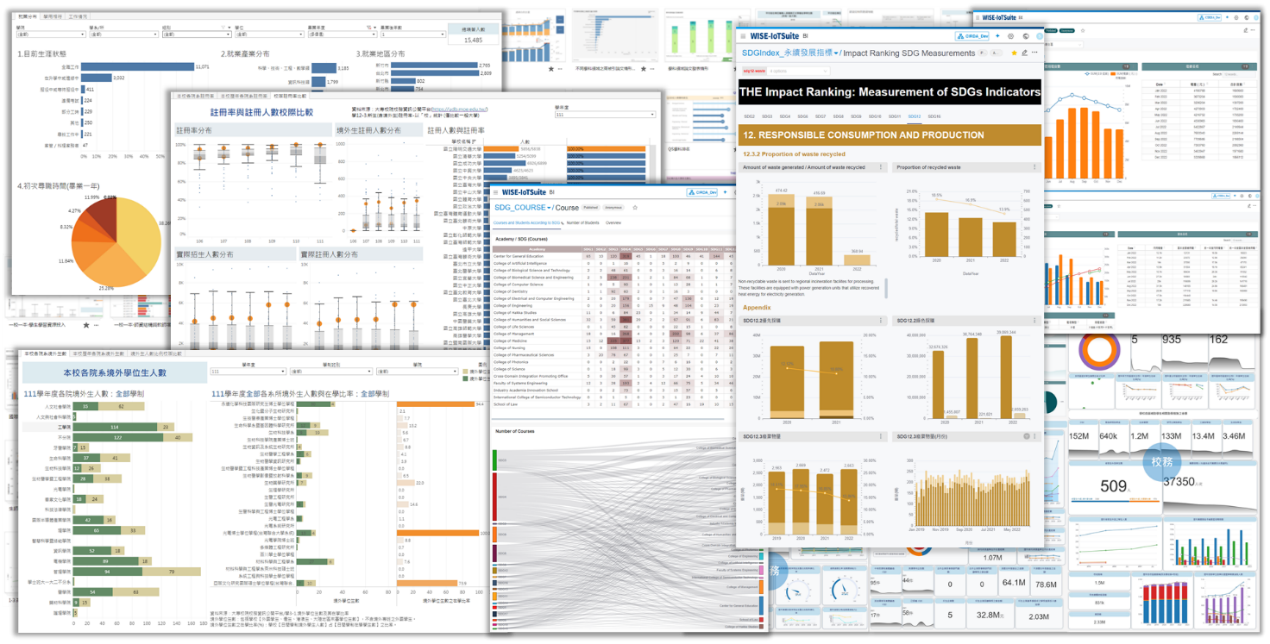
- 高影響力國際期刊論文發表:本校校務大數據研究中心建置「校務研究數據視覺化儀表板平台」(如下圖所示),計算SSCI/SCIE/TSSCI/A&HCI/THCI國際期刊的跨學科合作論文數量,並追蹤FWCI(Field-Weighted Citation Impact)指標,以評估本校跨領域論文的影響力。此外,本校建有「研發優勢分析平台(NYCU Academic Hub)」,此平台串接論文資料庫並整合校內研發資料庫,包含研發指標資訊系統、產學合作計畫系統、專利資訊系統、人事管理系統等數個資料庫,以有效追蹤教研人員各研究領域動態。
- 跨領域研究計畫:本校研究發展處與產學共創處計算由國科會、教育部、產業界等單位支持的跨學科研究計畫數量與獲得的總經費,並監測與國際頂尖大學、研究機構或企業的合作研究項目數量與合作成果。2024年度資料統計,本校共有逾2500件與官、產、學及非營利組織之間的合作案件,促進機構之間的跨領域學術、研究與技術交流,總計投入資金超過新台幣50億元,其中合作對象包含超過50間公家機構及200逾間學術機構,合作件數約1500件;產學合作對象則有超過400家業界廠商,件數超過500件;另有約200件案件與30逾間非營利組織合作。本校跨領域研究計畫詳細資訊如下表:
| 2024年跨領域及跨機構合作計畫件數與金額統計 | ||
| 案件屬性 | 件數 | 金額(新台幣/元) |
| 一般計畫 | 1223 | 3,016,804,380 |
| 計畫案 | 953 | 1,740,693,617 |
| 技術服務 | 267 | 57,791,837 |
| 其他案(非屬以上3類者) | 97 | 190,947,982 |
| 產學計畫 | 38 | 84,928,176 |
| 研討會 | 21 | 10,954,279 |
| 總計 | 2599 | 5,102,120,271 |
- 跨領域研究中心:本校受惠於獨特地緣產業發展條件,與眾多科技產業公司或機構合作,由業界力量支持設立研究或研發中心,更提供獎學機制予本校,使本校發揮專長項目之學術量能與跨領域優勢得以在產業界發光發熱,同時也培育未來高階優秀跨界人才,並確保學術研究能夠轉化為實際應用。本校跨領域/跨機構研究中心的詳細資訊如下表:
| 本校跨領域/跨機構研究中心 | |
| 跨領域設計科學研究中心 | 醫療人文跨領域研究中心 |
| ICF暨輔助科技研究中心 | 防疫科學暨健康一體研究中心 |
| 防災與水環境研究中心 | 人工智慧普適研究中心 |
| 腦科學研究中心 | 健康長壽與老化科學研究中心 |
| 數位醫學暨智慧醫療研究中心 | 健康科技創新與管理研究中心 |
| 陽明交大-台積電聯合研發中心 | 中華電信-陽明交大創新研究中心 |
| 聯發科技-陽明交大創新研究中心 | 廣達-陽明交大聯合AI研究中心 |
| 力積電-陽明交大研究中心 | 瑞昱-陽明交大創新研究中心 |
| 陽明交大-穩懋聯合技術創新中心 | 華邦電子集團-陽明交大研究中心 |
| 友達.陽明交大聯合研發中心 | 啓碁-陽明交大聯合研究中心 |
| NVIDIA.陽明交大聯合創新中心 | 交大-環球晶圓化合物半導體研究中心 |
| 緯創資通-陽明交大智慧與綠能產業創新聯合研發中心 | 樺漢-陽明交大ESG淨零轉型創新研究中心 |
| 緯創-交大嵌入式人工智慧研發中心 | 資策會交大聯合研發中心 |
| 陽明交大工研院聯合研發中心 | 陽明交大-IBM智慧物聯網與巨量資料分析研發中心 |
| 鴻海-陽明交大聯合研究中心 | 矽導研發中心 |
- 跨領域國際合作:本校透過教育部高等教育深耕計畫的經費挹注,建立跨國合作,例如:與日本東北大學共同成立聯合研究中心、與日本「物質‧元件聯盟」之合作、與臺北榮總及美國國衛院共同成立索拉茲跨國實驗室(Stephen J. Solarz International Laboratory)、與日本京都大學CiRA Foundation共同建置iPSC細胞實驗室。
- 社會影響與永續發展
本校監測跨領域研究對於聯合國永續發展目標(SDGs)的貢獻,評估跨領域研究對政府政策、產業創新與社會福祉的影響,例如部落之星:智慧偏鄉健康培力計畫、以電機小學堂進行STEM人才培育計畫。本校各項永續發展與社會責任議題相關之行動計畫如下表:
| 本校永續發展與社會責任議題相關之行動計畫 | ||
| 計畫/行動方案名稱 | 計畫/行動方案類型 | 計畫場域或合作單位 |
| 部落之星:智慧偏鄉健康培力計畫 | 教育部USR實踐計畫 | 宜蘭南澳鄉南澳村、武塔村 |
| 守護獨老:以科技轉譯為青銀共創全齡社區行動計畫 | 教育部USR實踐計畫 | 台北市北投區、三芝區及新竹市東區等 |
| 新竹六燃作為想像共同體:建構生態-文化永續體 | 教育部USR實踐計畫 | 新竹六燃大煙囪廠房保溫基地 |
| AIoT智慧物聯增能平台和程式設計教學 | 企業募款
校內SDGs補助專案 |
由台積電文教基金會贊助,於新竹、桃園等地國高中、國小執行 |
| 廢棄魚鱗回收3D列印循環設計創作與相關場域帶動 | 校內USR Hub計畫 | 水產廢棄物產生的相關場域 |
| 我們與部落的距離:利用跨領域學程建立大學社會責任的永續實踐 | 校內USR Hub計畫 | 新竹香山那魯灣聚落 |
| 課.城市:永續城市與社區課程創新發展計畫 | 校內USR Hub計畫 | 韓偉故居、台北市新北投及大稻埕 |
| 實驗室見習已提升離島高中師生科學研究力 | 校內USR Hub計畫 | 國立金門高中 |
| 以電機小學堂進行STEM人才培育計畫 | 校內USR Hub計畫 | 臺灣基督教長老教會五尖教會 |
| 臺灣冤獄平反協會服務實習計畫 | 校內USR Hub計畫 | 臺灣冤獄平反協會 |
| 社區口腔衛生教育數位轉型計畫 | 校內USR Hub計畫 | 台北、宜蘭、花蓮、雲林、台中、高雄等巡迴 |
| 西田社布袋戲文物典藏與研究發展計劃 | 校內USR Hub計畫 | 桃竹苗地區 |
| 愛盲有聲雜誌計畫 | 校內USR Hub計畫 | 國立臺灣圖書館 |
| 字在家鄉小天使:開發書寫學障快速篩檢系統與偏鄉學障孩童覺醒再生計畫 | 校內SDGs補助專案 | 南投埔里基督教醫院心理健康中心暨兒童發展聯合評估中心 |
| DIYGreen循環型農園 | 校內SDGs補助專案 | 幼兒園、國小、國高中與大專與大專院校院校 |
| 銀髮健身俱樂部計畫 | 校內SDGs補助專案 | 健身俱樂部設立於本校光復校區、博愛校區 |
| 審議民主的創新實作:臺灣淨零碳排公民審議 | 校內SDGs補助專案 | 與史丹佛大學審議民主研究中心合作之議題 |
| 社區心理衛生集力行動基地 | 校內SDGs補助專案 | 伊甸基金會活泉之家等非營利或社福機構 |
| NYCU SDGs 論文海報競賽(共2屆) | 校內SDGs系列活動 | 本校學生投稿 |
| SDG 宿舍生活節活動 | 校內SDGs系列活動 | 本校住宿學生 |
| 陽明交大永續周活動 | 校內SDGs系列活動 | 本校學生與教職員全體 |
Our university assesses the success of interdisciplinary research through multiple indicators to ensure that collaboration across different disciplines generates significant impact, enhances academic value, and promotes industrial application. The evaluation framework consists of three key aspects: (1) Education and Talent Cultivation, (2) Research and Development Outcomes, and (3) Social Impact and Sustainable Development.
Evaluation of Interdisciplinary Research Success
The university employs multiple indicators to assess the success of interdisciplinary research, ensuring that collaboration between different disciplines generates substantial impact and enhances the value of both academic and industrial applications. The primary measurement methods include:
1. Education and Talent Cultivation
● Interdisciplinary Degree Programs
The university currently has 34 departments offering 48 types of interdisciplinary second-major programs. There is also a university-level Arete Honors Program that is not restricted to any specific department, as well as several cross-college and cross-department degree programs, covering fields such as medicine, artificial intelligence, robotics, and optoelectronics. These programs provide students with diverse interdisciplinary learning opportunities and connect with industry and the international academic community. In addition, our university regularly evaluates the number of courses offered in each interdisciplinary program and student enrollment, and tracks the employment rates and industry collaboration opportunities of program graduates to ensure that program development aligns with academic trends and industry needs. Detailed information on each of our interdisciplinary degree programs is shown in the table below:
● General and Liberal Arts Education
The Liberal Arts program embraces an interdisciplinary and learning-by-doing approach, fostering a diverse and integrated learning environment. It encourages interdisciplinary learning and active engagement between students and their surroundings. Through case analysis, team projects, and social practice, students gain opportunities to apply their knowledge in real-world situations, deepen their academic skills, and develop a strong sense of social responsibility and practical abilities. Liberal Arts education integrates four major educational systems to cultivate well-rounded students: Professional Education, Research Education, General Education, Community Education. These four components create a comprehensive and mutually reinforcing learning model, equipping students with the necessary skills and knowledge to succeed in an ever-evolving academic and professional landscape.
● Cross-Domain Platforms and Learning Spaces
Our university’s ICT Creative Technology initiative focuses on innovative, forward-thinking research and development, emphasizing creativity, innovation, and interdisciplinary learning. This initiative enables all students to actively engage in cross-domain learning, exploring emerging technologies and contemporary topics. To foster collaboration, faculty members from various disciplines and colleges come together to create teacher communities, establish an interactive teaching platform, and develop ICT workshops. These initiatives encourage diverse teaching collaborations and provide students with opportunities for interdisciplinary learning. Through the design of practical courses, the program promotes interdisciplinary knowledge sharing, integration of diverse expertise, and hands-on learning experiences. Beyond the regular semester schedule, the university also utilizes flexible learning periods, such as weekends, holidays, and evenings, to offer short-term professional advanced courses to deepen expertise in specialized fields and general short-term introductory courses, allowing students from other disciplines to gain exposure to cross-domain learning opportunities.
2. Research and Development Results
● Publication of High-Impact International Journal Papers
The university’s Center for Institutional Research and Data Analytics has developed the “Institutional Research Data Visualization Dashboards” (as shown below) to monitor and assess interdisciplinary research outputs. This platform calculates the number of interdisciplinary collaborative papers published in SSCI, SCIE, TSSCI, A&HCI, and THCI international journals and tracks the Field-Weighted Citation Impact (FWCI) indicator to evaluate the influence and academic impact of the university’s cross-disciplinary research. Additionally, the university has established the “R&D Advantage Analysis Platform (NYCU Academic Hub)”, which integrates multiple research-related databases to provide a comprehensive view of the university’s research performance. This platform connects paper databases, R&D indicator information systems, industry-university collaboration project systems, patent information systems, and personnel management systems. By linking these systems, the platform enables efficient tracking of research trends across various disciplines, facilitates data-driven decision-making, and enhances interdisciplinary collaboration.
NYCU Institutional Research Data Visualization Dashboards
● Interdisciplinary Research Projects
The university’s Office of Research and Development and Office of Industry-Academia Cocreation track and evaluate the number of interdisciplinary research projects supported by the National Science Council, the Ministry of Education, industry, and other organizations. These offices also monitor total funding received, the number of collaborative research initiatives, and partnerships with top international universities, research institutions, and companies. In 2024, over 2,500 interdisciplinary research projects involving government, industry, academia, and non-profit organizations. Total investment exceeding NT$5.0 billion, fostering interdisciplinary academic, research, and technological exchanges. More than 50 public institutions and 200 academic institutions contributed to approximately 1,500 collaborative research projects. Over 400 industry partners, leading to more than 500 industry-academia collaboration projects. Around 200 projects in partnership with 30+ non-profit organizations. These interdisciplinary collaborations strengthen knowledge-sharing, innovation, and technological advancement, reinforcing the university’s role as a hub for academic and industry-driven research. Below is a detailed breakdown of the university’s interdisciplinary research projects:
| Statistics on Interdisciplinary Research Projects in 2024 | ||
| Case Attributes | Number of Cases | Amount (NTD/Yuan) |
| General plan | 1223 | 3,016,804,380 |
| Project | 953 | 1,740,693,617 |
| Technical service | 267 | 57,791,837 |
| Other cases | 97 | 190,947,982 |
| Industry-Academic project | 38 | 84,928,176 |
| Seminar | 21 | 10,954,279 |
| Total | 2599 | 5,102,120,271 |
● Interdisciplinary/Interinstitutional Research Centers
The university leverages its unique geographical advantages for industrial development and collaborates with numerous technology companies and institutions. These industry partnerships support the establishment of research and R&D centers, while also providing scholarships to enhance academic excellence. These collaborations play a crucial role in cultivating future high-level interdisciplinary talent and ensuring that academic research is successfully translated into real-world applications. The following is detailed information on our interdisciplinary and inter-institutional research centers:
| NYCU’s Interdisciplinary/Interinstitutional Research Centers | |
| Transdisciplinary Design Innovation Shop | Interdisciplinary Medical Humanities Research Center |
| ICF and Assistive Technology Research Center | Research Center for Epidemic Prevention Science and One Health |
| Disaster Prevention and Water Environment Research Center | Pervasive Artificial Intelligence Research (PAIR) Labs |
| Brain Science Research Center | Center for Healthy Longevity and Aging Science |
| Digital Medicine and Smart Healthcare Research Center | Center for Healthy Technology Innovation and Management |
| NYCU-TSMC Joint Research Center | Chunghwa Telecom-NYCU Innovation Research Center |
| MediaTek-NYCU Innovation Research Center | Quanta-NYCU Joint AI Research Center |
| PSMC-NYCU Research Center | Realtek-NYCU Innovation Research Center |
| NYCU-Win Semi Joint Technology Innovation Center | WiseTech-NYCU Joint Research Center |
| AUO-NYCU Joint Research Center | WCS-NYCU Joint Research Center |
| NVIDIA-NYCU Joint Innovation Center | NYCU-GlobalWafers Compound Semiconductor Research Center |
| Wistron-NYCU Smart & Green Industry Innovation Joint Research Center | Hua Han-NYCU ESG Net Zero Transformation Innovation Research Center |
| Wistron-NYCU Embedded AI Research Center | Institute for Information Industry-NYCU Joint Research Center |
| NYCU-ITRI Joint Research Center | NYCU-IBM Joint Research Center |
| Foxconn-NYCU Research Center | Silicon Conductor Research Center |
● Interdisciplinary International Cooperation
The university has established cross-border collaborations through funding from the Ministry of Education’s Higher Education Deepening Plan. These initiatives include (1) Establishing a joint research center with Tohoku University in Japan; (2) Collaborating with Japan’s Material and Components Alliance to advance research and development; (3) Establishing the Stephen J. Solarz International Laboratory in partnership with Taipei Veterans General Hospital and the U.S. National Institutes of Health (NIH); (4) Co-founding an iPSC (Induced Pluripotent Stem Cell) Laboratory with the CiRA Foundation at Kyoto University, Japan. These interdisciplinary and international partnerships strengthen academic exchange, research innovation, and industrial collaboration, reinforcing the university’s global research impact.
3. Social Impact and Sustainable Development
The university actively monitors the contributions of interdisciplinary research to the United Nations Sustainable Development Goals (SDGs) and evaluates its impact on government policies, industrial innovation, and social welfare. Key initiatives include:
(1) Tribe Star: Smart Rural Health Empowerment Program, which leverages technology to enhance healthcare services in rural communities, and (2) STEM Talent Training Program through the Electrical Primary School, designed to foster early-stage STEM education and cultivate future talent in science and technology. The university is committed to sustainable development and social responsibility, implementing various action plans to address global and societal challenges. The detailed initiatives related to sustainability and social responsibility are outlined as follows:
| Action Plans Related to the University’s Sustainable Development and Social Responsibility Initiatives | ||
| Project/Action Plan Name | Type of Plan/Action Plan | Project Sites or Cooperation Units |
| Tribal Star: Smart Rural Health Empowerment Project | USR implementation plan of the Ministry of Education | Nan’ao Village and Wuta Village, Nan’ao Township, Yilan |
| Protecting the Elderly: Using Technology to Translate Youth and Banks to Create an All-Age Community Action Plan | USR implementation plan of the Ministry of Education | Beitou District, Sanzhi District, and East District, Hsinchu City, Taipei City |
| Hsinchu Six Fuel as an Imagination Community: Constructing Eco-Cultural Sustainability | USR implementation plan of the Ministry of Education | Hsinchu Six Fuel Large Chimney Factory Insulation Base |
| AIoT Smart IoT Empowerment Platform and Programming Teaching | Corporate fundraising | Sponsored by TSMC Educational Foundation, implemented in Hsinchu, Taoyuan, and other locations |
| Recycling of Wasted Fish Scales, 3D Printing, Circular Design Creation, and Related Field Promotion | SDGs subsidy project in school | Sites generating aquatic waste |
| The Distance Between Us and the Tribe: Using Cross-Disciplinary Programs to Establish Sustainable University Social Responsibility Practices | USR Hub project in school | Hsinchu Xiangshan Naluwan Village |
| Course. City: Sustainable city and community curriculum innovation development plan | USR Hub project in school | Han Wei’s former residence, Taipei City Xinbeitou, and Dadaocheng |
| Laboratory Internship to Improve Scientific Research Abilities of High School Teachers and Students in Outlying Islands | USR Hub project in school | National Kinmen High School |
| STEM talent training program with electrical elementary school | USR Hub project in school | Taiwan Christian Presbyterian Church Wujian Church |
| Taiwan Injustice Rehabilitation Association service internship program | USR Hub project in school | Taiwan Wrongful Imprisonment Redress Association |
| Community oral hygiene education digital transformation plan | USR Hub project in school | Tours in Taipei, Yilan, Hualien, Yunlin, Taichung, Kaohsiung, etc. |
| Xitian Society puppetry cultural relics collection and research development plan | USR Hub project in school | Taoyuan, Hsinchu, Miaoli |
| Love the blind audio magazine project | USR Hub project in school | National Taiwan Library |
| Writing in Hometown Little Angels: Development of a Rapid Screening System for Writing Learning Disabilities and Awakening & Regeneration Plan for Children in Remote Areas | USR Hub project in school | Mental Health Center and Child Development Joint Assessment Center of Puli Christian Hospital in Nantou |
| DIY Green Circular Farm | SDGs subsidy project in school | Kindergartens, elementary schools, junior high schools, colleges, and universities |
| Senior Fitness Club Project | SDGs subsidy project in school | Fitness clubs established at Guangfu Campus and Boai Campus |
| Innovative Implementation of Deliberative Democracy: Taiwan’s Net Zero Carbon Emission Citizen Deliberation | SDGs subsidy project in school | Cooperation with the Center for Deliberative Democracy Research at Stanford University |
| Community Mental Health Collective Action Base | SDGs series of activities in school | Non-profit or social welfare organizations such as the Eden Foundation Fountain House |
| NYCU SDGs Paper Poster Competition (2 sessions) | SDGs series of activities in school | Non-profit or social welfare organizations such as the Eden Foundation Fountain House |
| SDG Dormitory Life Festival | SDGs series of activities in school | Boarding students |
| NYCU Sustainability Week | SDGs series of activities in school | Open to all students and faculty members |